
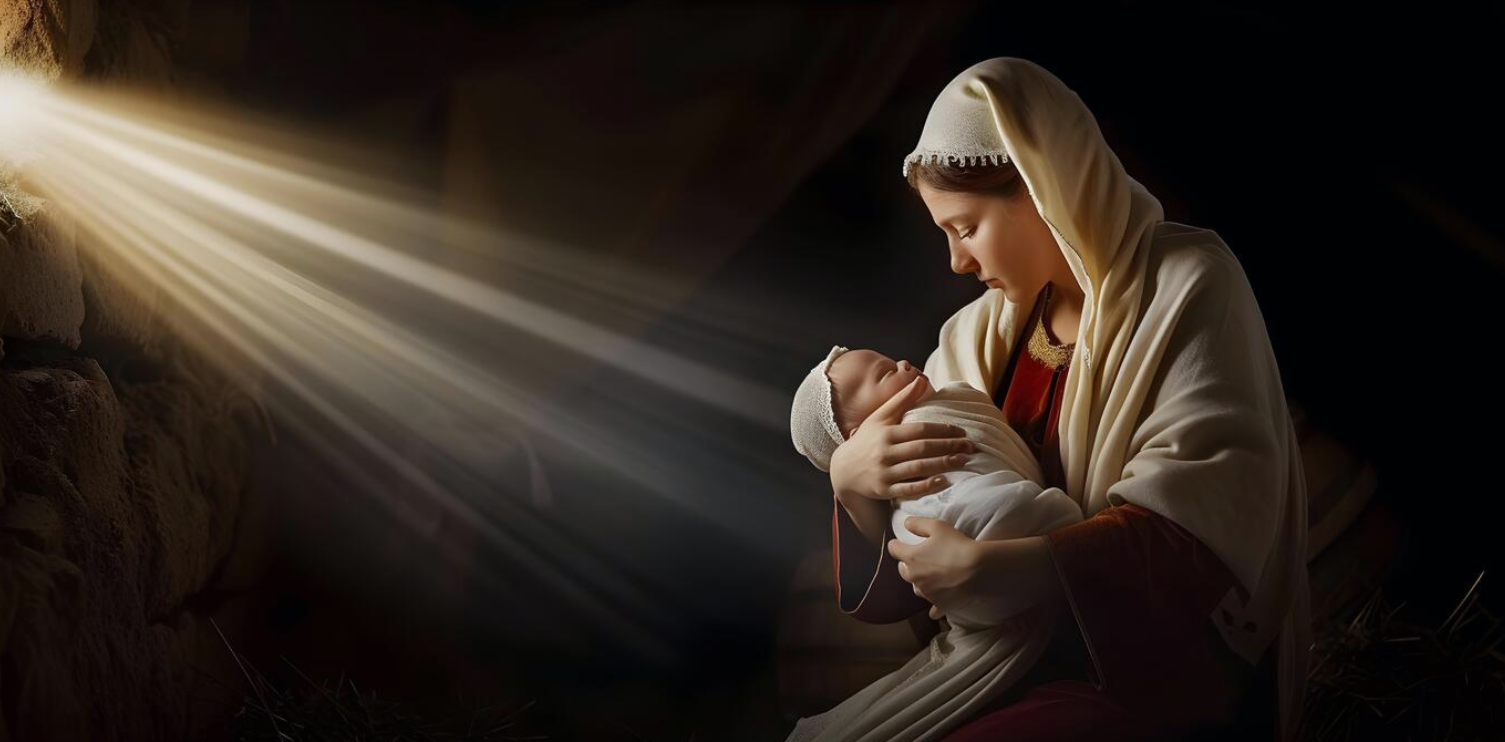
John’s Gospel reveals that the birth of Jesus Christ was the entrance of eternity into time. The eternal Word became flesh so that fallen humanity could be reconciled to God. Christmas is not about atmosphere; it is about incarnation.
By Evangelist Peter Gee, Editor in Chief, Christianity News Daily
12/09/2025
Introduction
The Gospel of John approaches the birth of Jesus Christ from a perspective unlike any other account in Scripture. While Matthew emphasizes kingship and Luke highlights humility, John lifts the reader’s eyes to eternity. Rather than beginning with a manger, angels, or shepherds, John opens with a cosmic declaration that reaches back before creation itself. His purpose is unmistakable: to reveal that the child born in Bethlehem is the eternal Word of God—uncreated, divine, and essential for humanity’s relationship with God.
John does not narrate the mechanics of the nativity scene, yet his Gospel provides the most profound explanation of why the incarnation was necessary. He explains not merely how Jesus was born, but who Jesus is and why His entrance into human history was the only solution to humanity’s spiritual separation from God.
The Eternal Nature of Christ
John begins with one of the most theologically rich statements in Scripture: “In the beginning was the Word, and the Word was with God, and the Word was God” (John 1:1). This verse establishes that Jesus Christ did not come into existence at His birth. He existed eternally with the Father and shared fully in the divine nature.
By using the phrase “in the beginning,” John intentionally echoes Genesis 1:1, linking Christ directly to creation. The Word was not created; He is the Creator. John affirms this truth in verse 3, stating, “All things were made through Him, and without Him nothing was made that was made.” The One who lay in a manger is the same One who spoke the universe into existence.
This truth distinguishes Christianity from every other worldview. Jesus Christ is not merely a moral teacher, prophet, or spiritual guide. He is the eternal God, the source of life itself.
The Meaning of the Word
John refers to Jesus as “the Word” (Logos), a term loaded with meaning for both Jewish and Greek audiences. To the Jewish mind, God’s Word was the agent of creation and revelation. Psalm 33:6 states, “By the word of the Lord the heavens were made.” To the Greek mind, logos represented reason, order, and meaning.
By identifying Jesus as the Word, John declares that Christ is God’s ultimate self-revelation. God did not merely speak through prophets; He spoke through His Son. Hebrews 1:1–2 confirms this truth, declaring that God, who spoke through the prophets, “has in these last days spoken to us by His Son.”
The Word Became Flesh
John reaches the heart of the incarnation in John 1:14: “And the Word became flesh and dwelt among us.” This statement captures the miracle of Christmas in theological clarity. God did not remain distant from humanity’s suffering. He entered it.
The phrase “dwelt among us” literally means “tabernacled.” Just as God’s glory once filled the tabernacle in the wilderness, His presence now resided in human form. Jesus Christ embodied God’s dwelling place among humanity.
The incarnation was necessary because humanity’s problem was not ignorance but sin. Only God Himself could bridge the divide caused by rebellion. The Word became flesh not to observe humanity, but to redeem it.
Light Entering Darkness
John portrays Christ as the genuine Light entering a darkened world. “In Him was life, and the life was the light of men” (John 1:4). Darkness in Scripture represents sin, ignorance, and separation from God. Humanity did not evolve toward enlightenment—it descended into spiritual darkness.
John declares, “The light shines in the darkness, and the darkness did not comprehend it” (John 1:5). Christ’s birth confronted the darkness of human sin. Though many rejected Him, the light could not be extinguished.
This theme confronts modern distortions of Christmas. Christ was not born to decorate culture, but to expose darkness and offer salvation.
John the Baptist and the Witness to the Light
John clarifies that John the Baptist was not the Light, but a witness to the Light (John 1:8). This distinction matters. Throughout history, humanity has often elevated messengers above God. John redirects all attention to Christ.
John the Baptist later testified, “Behold! The Lamb of God who takes away the sin of the world!” (John 1:29). This declaration connects the incarnation to the cross. Jesus was born to die, and His death was the means by which sin would be removed.
Rejection and Reception of the Incarnate Word
John does not romanticize the incarnation. He acknowledges rejection: “He came to His own, and His own did not receive Him” (John 1:11). The Creator entered His creation, yet many failed to recognize Him.
However, John offers hope: “But as many as received Him, to them He gave the right to become children of God” (John 1:12). Christ’s birth made reconciliation possible. Through faith, humanity can be restored to a relationship with God—not through works, but through grace.
Grace and Truth Through Jesus Christ
John contrasts the law given through Moses with the grace revealed through Christ. “For the law was given through Moses, but grace and truth came through Jesus Christ” (John 1:17). This does not diminish the law but reveals its fulfillment.
The law exposed sin; Christ removed it. The incarnation ushered in an era of grace grounded in truth. Without truth, grace becomes sentimental; without grace, truth condemns. Jesus embodied both perfectly.
Why Humanity Needed God in the Flesh
John’s Gospel addresses a crucial reality: humanity could not ascend to God. God had to descend to humanity. Sin created a chasm no human effort could bridge. Philosophies, religions, and rituals all fall short.
Only the incarnation provided the solution. Jesus Christ lived without sin, obeyed the Father perfectly, and revealed God fully. He later declared, “He who has seen Me has seen the Father” (John 14:9). The birth of Christ was the beginning of God’s rescue mission for a fallen world.
The Incarnation and the Cross
While John does not narrate the manger, he never disconnects the incarnation from the crucifixion. Jesus repeatedly stated that He came to lay down His life (John 10:11). Christmas points forward to Calvary.
The Word became flesh so He could become a sacrifice. Hebrews 2:14 explains that Christ shared in humanity “that through death He might destroy him who had the power of death.” The incarnation made redemption possible.
Christmas Beyond Sentimentality
John challenges modern celebrations that reduce Christmas to nostalgia. The birth of Christ demands a response. Jesus Himself declared, “I am the way, the truth, and the life” (John 14:6). Neutrality is not an option.
To ignore Christ is to remain in darkness. To receive Him is to receive life eternal. The incarnation divides humanity between belief and unbelief, light and darkness.
Conclusion
John’s Gospel reveals that the birth of Jesus Christ was the entrance of eternity into time. The eternal Word became flesh so that fallen humanity could be reconciled to God. Christmas is not about atmosphere; it is about incarnation.
The child born in Bethlehem is the eternal Creator, the Light of the world, and the only Savior of humanity. Without Him, humanity remains lost. With Him, eternal life becomes possible. The Word has spoken. The Light has come. The question remains—will the world receive Him?